Korea to relocate 44 government bodies from Seoul to Sejong by 2031
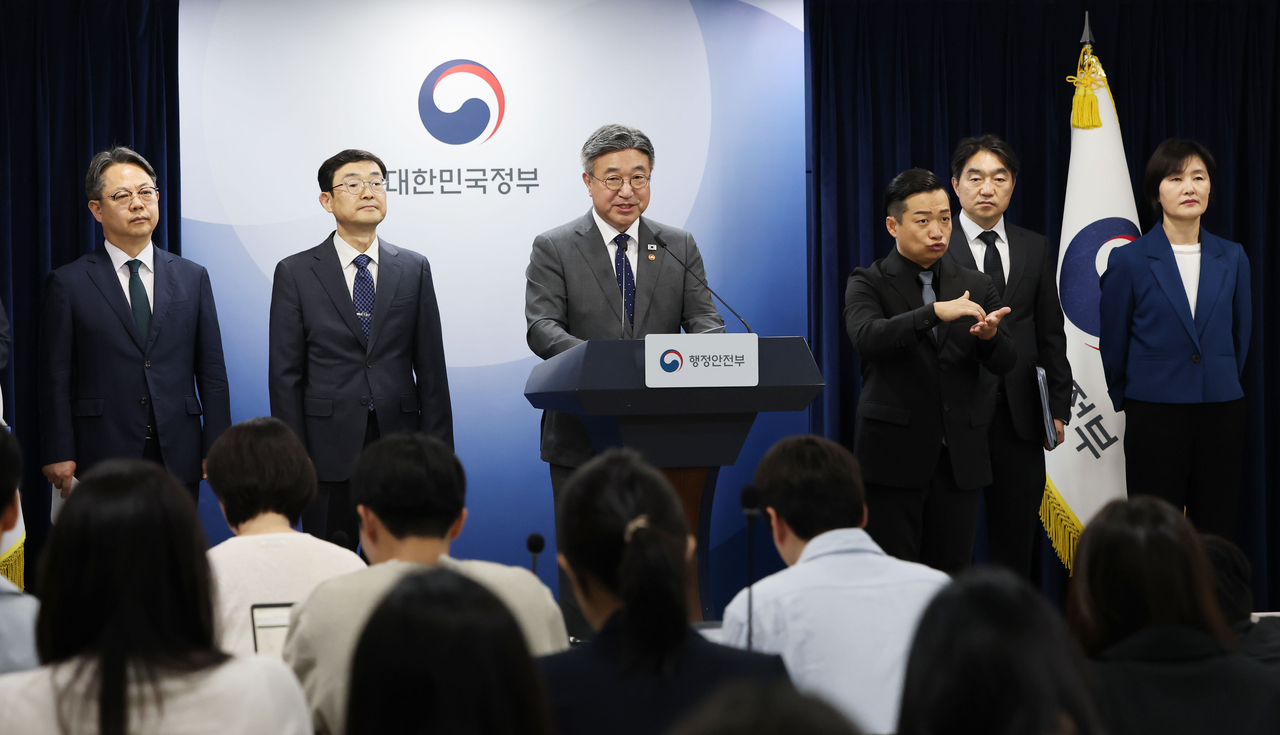
Defense and foreign affairs ministries, along with 42 other government bodies, will relocate to Sejong by 2031, the government announced Tuesday as Seoul pushes to accelerate relocation out of the capital region.
The relocation would involve 9,929 employees and cost an estimated 3.1 trillion won ($2.3 billion), according to Interior Minister Yoon Ho-jung.
Seoul will also establish a presidential office and National Assembly building in Sejong by 2029 and 2033, respectively. The two bodies will not fully move to the city.
The plan follows the government's Sept. 3 announcement of guidelines for relocating central administrative agencies, as well as subsequent consultations with relevant institutions and experts.
Sejong saw its first major relocation of central government agencies between 2012 and 2014, when 43 government bodies with a combined workforce of 14,731 were moved to the city.
The Ministry of Foreign Affairs and the Ministry of Unification were excluded from these relocations to maintain proximity to foreign diplomatic missions and North Korea, respectively.
Both ministries were included in the latest plan after their relocation was raised for consideration in the government's September announcement.
The relocation is also expected to precede the completion of the Sejong presidential office and National Assembly.
"The relocation of central government bodies to Sejong is a key national strategy to promote sustainable growth and a new leap forward for the Republic of Korea by addressing excessive concentration in the capital region and making more efficient use of the country's territory," Yun said at the briefing.
Once all central government ministries in Seoul have been relocated, only affiliated agencies responsible for direct public services will remain in Seoul, Incheon and Gyeonggi Province, out of the 142 government agencies currently located in the capital region.
Which agencies will move, and when?
Of the 44 bodies, 27 that do not require new buildings will move into rented office space in Sejong by the end of 2027.
Six bodies will relocate during the first half of the year: the Korea Media and Communications Commission, the Personal Information Protection Commission, the Nuclear Safety and Security Commission, the National Human Rights Commission, the National Education Committee, and the Overseas Koreans Agency.
These will be followed in the second half by 19 others, including the Financial Services Commission. The 27 bodies account for an expected 2,995 employees.
The list also includes the Ministry of Justice and the Ministry of Gender Equality and Family. The relocation schedule for the two ministries will be determined after revisions to the Special Act on the Construction of the Multifunctional Administrative City as they are currently not among agencies subject to relocation to Sejong.
The remaining 17 bodies, which require specialized facilities or separate buildings for security reasons, are expected to move by 2031, involving 6,934 employees.
They include the Ministry of Foreign Affairs, the Ministry of Unification, the Ministry of National Defense, the Board of Audit and Inspection, the National Police Agency, the Prosecution Service, the Serious Crimes Investigation Agency, and the Corruption Investigation Office for High-ranking Officials.
Vows for seamless process
To prevent disruptions to public services, including civil complaints and licensing procedures, each agency will draw up measures to ensure continuity of operations during the relocation.
The government also plans to support relocating employees and minimize public inconvenience during the process.
Measures will include assistance with moving expenses and early settlement costs, as well as temporary transportation for civil servants who cannot immediately relocate due to housing arrangements or the need to wait until their children's school term ends.
Yun also said the government would continue consultations with the National Assembly on revisions to the administration city act.
"Given that this is a decision for the country's future, I ask for the cooperation of employees at the agencies subject to relocation," Yun said. "We will proceed with the move while thoroughly preparing all necessary measures to minimize inconvenience to the public and help the relocating agencies settle in smoothly."
forestjs@heraldcorp.com